A method reminiscent of the Cold War. All over the world, associations, independent media outlets and NGOs – all which often constitute the last critical bulwark against totalitarian abuses – are facing new laws aimed at curbing their activities by depriving them of means, and at discrediting them. In most cases, this roots from the genuine paranoia of closed political regimes and their leaders when faced with organisations that they suspect of serving the interests of foreign powers, or of political opponents in exile.
The practice is not new, it originated in the United States. From 1938 onwards, the American authorities became obsessed with the idea of a Nazi, and then Soviet, fifth column operating within their territory. In 1938, Washington passed a law imposing strict controls on NGOs working in the country which received foreign funds and carried out “political activities”. McCarthyism in the 1950s, in a context of East-West opposition, naturally aggravated this situation. The result was an exacerbated ideological propaganda campaign which for a long time paralysed many American NGOs, relegating them to the rank of “foreign agents”. As the saying goes: “Give a dog a bad name and hang him”, many activists lost their freedom for their defence of civil rights or trade unions.
The Russian laboratory
Since the Cold War, many regimes have taken up this authoritarian approach against civil society and the media in their countries, such as Greece under the Colonels.More recently, Ethiopia, adopted a repressive law that paralysed the activities of a large number of human rights NGOs which received foreign funding between 2009 and 2019. But, above all, in a reversal of historical trends, it was Vladimir Putin who most notably revived these measures in the early 2010s to attack NGOs working in Russia. As early as 2012, legislative measures mentioned the established term “foreign agents”, to implicate those suspected of carrying out an activity considered as “political” and in favour of differing interests. This loose and expandable definition consists of those wanting to influence government decision-making in order to change state policy. It is an interpretation that targets the very functioning of many civil society organisations. Often, it is the source of an organisationxe2x80x99s donations and funding that is singled out to claim its affiliation with the “enemy”.
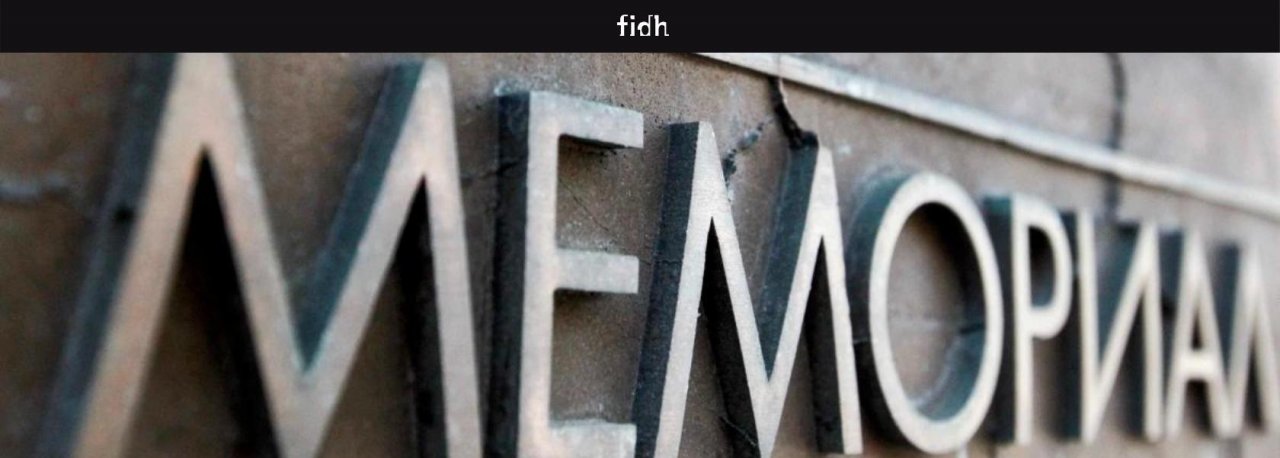
Thus, the simple fact of wanting – for example – to re-establish a historical truth, or to defend the rights of LGBT people, can lead to being labelled as an agent in the service of foreign powers, naturally hostile to the Kremlinxe2x80x99s policies. Several Russian NGOs have been prosecuted under this legislation, and some have been forced to disband. FIDHxe2x80x99s member organisation in Russia, Memorial Human Rights Centre, for example, is regularly confronted with this.
In another category, some institutions, such as the former Perm 36 Museum which denounced the crimes of the Soviet regime, was itself declared a xe2x80x9cforeign agent”. Following an administrative closure, it was ultimately taken over by the regime and more or less wiped out.
Since 2014, no less than seven legislative amendments have further restricted the ability of Russian NGOs to act. This includes the obligation to register with the authorities, a law that since 2017 has targeted the media, activists and independent journalists. Since April 2021, the Riga-based Russian and English language news website Meduza, for example, has been one of the main targets on the list of “foreign agents”. Four months later, the independent television channel Dojd and the investigative journalism website IStories were also placed on the list of news or analysis sites that are termed “foreign agents”, joining the Sova centre, which focuses on issues of nationalism and xenophobia, and has been on the list since December 2016. Independent journalist organisations have also been targeted. In August 2021, the Union of Freelance Journalists of the Perm region Chetvjortyj Sektor was added to the register. This legislative and judicial relentlessness, aimed at stifling any opposition, leaves no leeway for civil society or political opposition.
n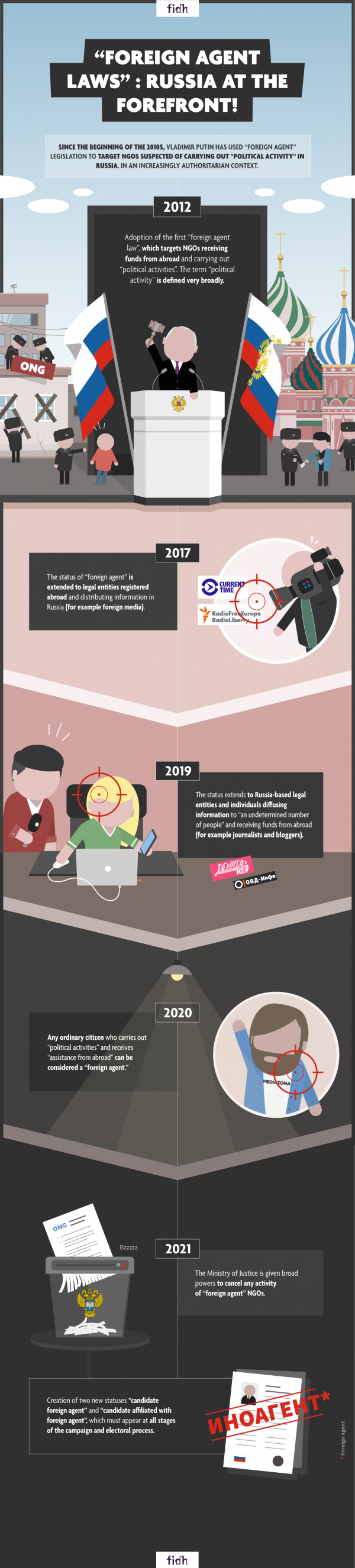
Nationalist and xenophobic rhetoric
This draconian approach has now been extended to target ordinary citizens guilty of “political activity” on social media, and who since 2020 are also at risk of being prosecuted as “foreign agents”. Anyone who directly or indirectly receives financial or methodological support from abroad can fall into this category.
The trend has spread around the world. For example, in the former provinces of the Soviet Union which are still under Moscowxe2x80x99s influence, such as Azerbaijan, Kyrgyzstan, where a draft law was finally abandoned in 2016, or Ukraine, where similar legislative proposals are under discussion. But also in Israel, and even within the European Union (Hungary, Bulgaria, Poland, etc.), where the rise of ultra-conservative populism has encouraged the adoption of such draconian measures. In Latin America, too, the simplicity, effectiveness and even popularity of this repressive system, which plays on nationalism and xenophobia, has greatly seduced certain regimes. The same terminology and procedures are used to restrict the activities of civil society and NGOs, all in the name of fighting against foreign influence.
An example is Venezuela, where a “Law on International Cooperation” has been discussed several times, with the aim of controlling the funds that Venezuelan civil society organisations can access. Although this law has not been approved, it is currently on the agenda of the National Assembly, elected in December 2020. In the meantime, the Venezuelan government has been imposing strict control measures on non-governmental organisations on the basis of the “Law against Organised Crime and Terrorist Financing”. The administrative decision approved on 3 May 2021 obliges, for example, all non-profit organisations – including individuals and legal entities – to register with the National Office against Organised Crime and the Financing of Terrorism (ONCDOTF), before they can operate. These organisations must provide information about their domestic or foreign funders, as well as a list of allied organisations abroad with which they have agreed to collaborate.These conditions affect their access to funding and criminalise Venezuelan civil society organisations and their allied partner organisations in the country.
xe2x80x9cIn Nicaragua, the enemy from withinxe2x80x9d
In this Central American state, the exploitation of “laws against foreign agents” seems to be reaching a climax. April 18th, 2018 marks a shift in Nicaragua towards an even more authoritarian regime. The Statexe2x80x99s position is based on the systematic denial of the existence of attacks and harassment against human rights defenders and political opponents. Furthermore, the government justifies its own attacks by labelling organisations as “promoters of violence”. These justifications support a narrative of there being a permanent risk of a “coup dxe2x80x99xc3xa9tat”, allegedly being plotted by human rights defenders and political opposition.
Within this context, between October 2020 and January 2021, several laws and a constitutional reform were passed by the Ortega-Murillo regime, threatening the fundamental rights and freedoms of Nicaraguan civil society. These laws particularly target individuals, human rights organisations, and notably journalists: the law on the regulation of foreign agents, the special law on cybercrime, the reform of Article 37 of the Constitution on life imprisonment, and the law for the defence of the peoplexe2x80x99s rights to independence, sovereignty and self-determination for peace. These laws contravene international human rights laws and provide dangerous and additional repressive tools. They underscore the notion of an xe2x80x99enemy withinxe2x80x99, whereby human rights defenders are labelled as xe2x80x99traitorsxe2x80x99 and xe2x80x99enemies of the homelandxe2x80x99. The result is their increasing degree of isolation and lack of resources and protection from persecution by the state apparatus.
Moreover, since June 2021, civil society has lived in fear of raids and arbitrary detentions. Several of its representatives have already been detained by the Nicaraguan authorities and investigated under “Law 1055 of 2020”, the reform of the Penal Code and “Law 1040 on the regulation of foreign agents”. References to “foreign agents” and “cybercrimes” are clearly used in an arbitrary manner to criminalise any form of opposition. They allow for the closure of media outlets and hinder the work of NGOs by limiting access to funding for defenders, all of whom are labelled as “foreign agents” or “terrorists”. At least two recognised civil society organisations have decided to suspend their activities as a result of these draconian laws: Fundacixc3xb3n Violeta Chamorro and Pen International. In such a context, with no opposition and no respect for human rights, one can certainly no longer speak of democracy in Managua.
n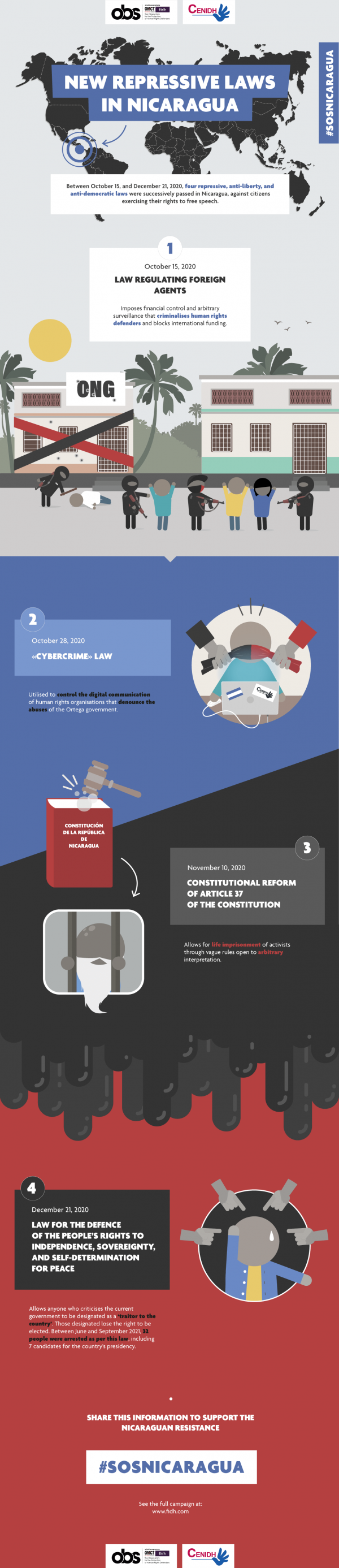
David against Goliathn
FIDHxe2x80x99s members and partners are included in the many human rights organisations targeted around the world. We fight every year to help them overcome the legislative and material obstacles which hinder their actions. We provide them with legal assistance, and alert international bodies of their situation. We also lobby for the adoption of laws to safeguard the independence of civil society, and to create an appropriate environment for their activities. Sometimes this activism pays off: recently the European Court of Human Rights ruled that Hungaryxe2x80x99s anti-NGO law was a clear violation of fundamental rights.
But often, taking action is tantamount to the fight between David and Goliath. Our organisations are increasingly accused of being “enemies guided by the outside”, with a “political agenda” of removing leaders or influencing people against the “values” defended by the ruling power (religious, communist, nationalist, conservative, etc.).
Despite all our advocacy efforts, totalitarian, authoritarian or semi-democratic regimes, now “financed” and protected even within the United Nations human rights bodies by states such as Russia or China, are increasingly succeeding in silencing their civil society by depicting the most threatening NGOs as harmful foreign bodies that need to be monitored or even eradicated.
A race against time
This strategy even inspires states that are radically opposed to the international scene, such as Iran and Israel, united by their development of similar regulations, practices and/or narratives to stigmatise the alleged activities of “foreign agents”. In countries where they can defend themselves, NGOs waste precious time in long and costly procedures to register or justify the source of their funding. This wastes energy that could be used by them to carry out their missions. Elsewhere, laws and charges against “foreign agents” pave the way for the persecution of human rights defenders.
This map is not exhaustive, but it shows you the danger of these practices and laws and their extent. It demonstrates the need to combat them, so that organisations working for the common good can continue to do so in complete freedom. It is not inevitable that these practices will spread like a bad spy novel: we need everyonexe2x80x99s support to design an alternative, inclusive, and truly human rights-based future.